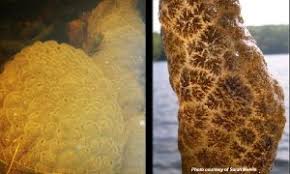
Have you happened to spot any odd looking blobs around the lake? If you did, you were looking at a Bryozoan colony. Dan Sharpe reports that he spotted two on the east side of the lake recently. According to the Lake Stewards of Maine website, Bryozoans are “… tiny colonial invertebrate animals belonging to the phylum ‘bryozoa’, and are also known as “moss animals”. There are 20 freshwater species worldwide. A bryozoan colony, consisting of individuals called zooids, may resemble a brain-like gelatinous mass and be as big as a football, and can usually be found in shallow, protected areas of lakes, ponds, streams and rivers, and is often attached to things like a mooring line, a stick, or a dock post, etc.” While Bryozoans are not good to eat and they are a little creepy looking, they are good for the lake. They eat algae and are usually a sign of good water quality. So odd as they may look, they are a happy sight for our lake. You can find more information about them here: https://www.lakestewardsofmaine.org/programs/other-programs/bryozoans/ and https://nature.mdc.mo.gov/discover-nature/field-guide/bryozoans-moss-animals#:~:text=Bryozoans%20are%20microscopic%20aquatic%20invertebrates,a%20rock%20or%20submerged%20branch.